

Last updated: May 19, 2026
Anyone searching for pickpack vs onfleet israel is usually not asking which logo looks more familiar. They are asking which platform can run a delivery operation with less friction, better control, and stronger local fit in Israel. (all PickPack comparisons)
That is the real comparison between PickPack and Onfleet. One question sits underneath it: is the team solving only the route, or the full day of dispatch, driver execution, customer messaging, proof, and analytics?
Quick summary
- This comparison is about operational fit, not logo size: Onfleet may fit simpler use cases, while PickPack is stronger when execution control matters.
- The Israeli decision criteria usually start with local fit: Priority ERP and SAP Israel integration, Dynamic dispatch and real-time rerouting, and WhatsApp-native customer messaging.
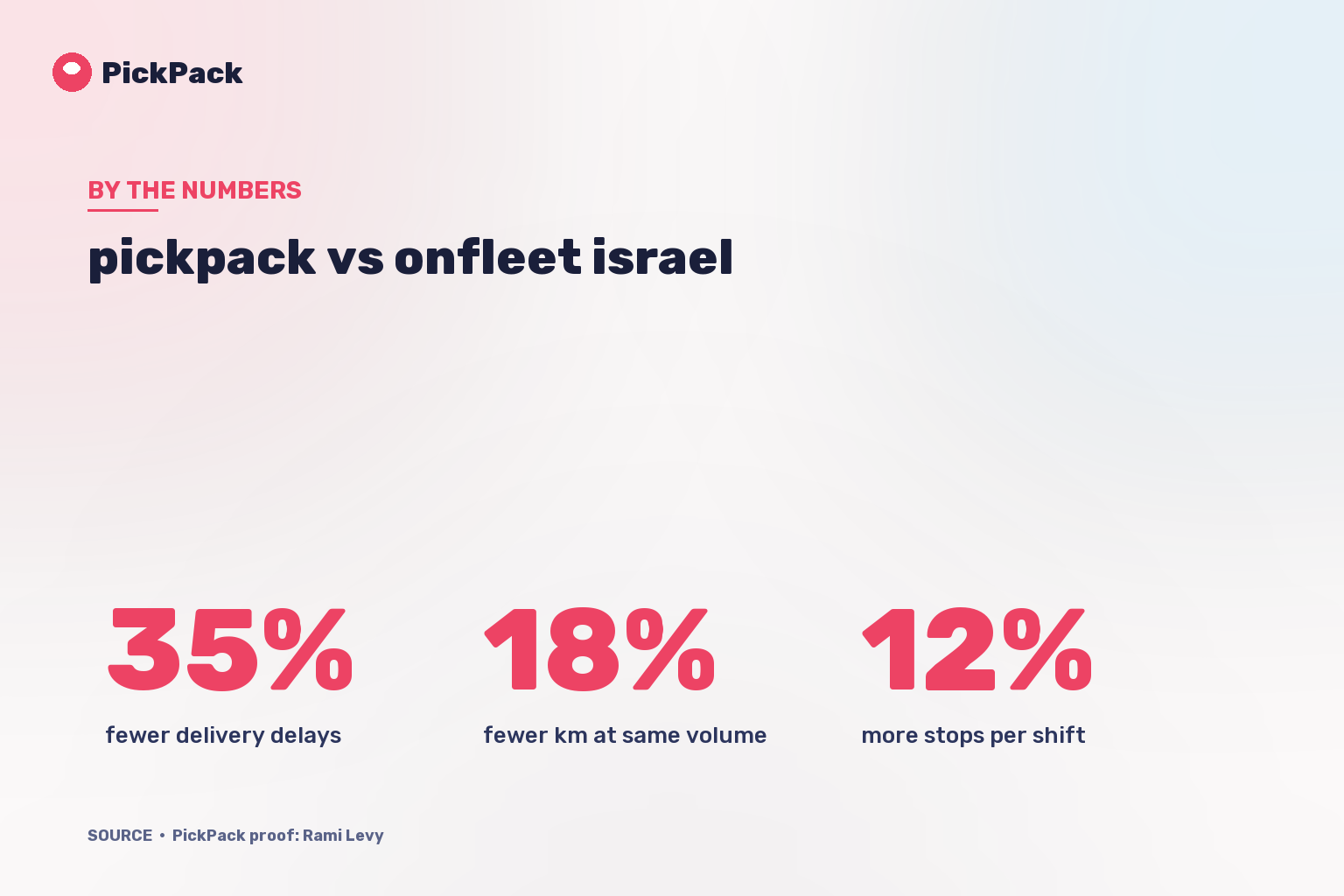
- Named proof matters more than marketing copy. The anchor metric in this article is: 35% fewer delivery delays, 18% fewer kilometers at the same volume, and 12% more stops per shift.
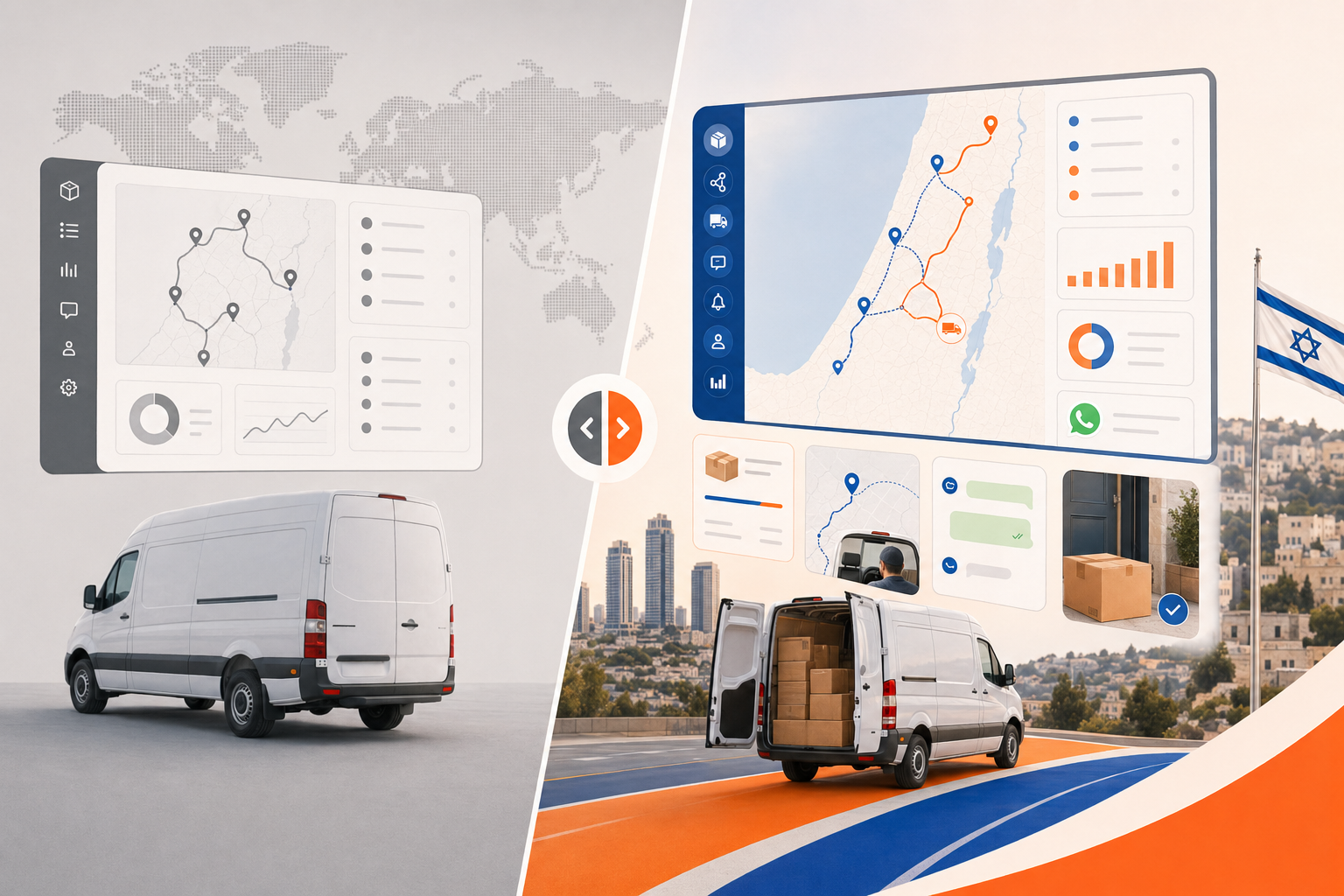
Why this matters in Israel
The Israeli fit question is usually practical: can the system support Priority ERP and SAP Israel integration, Dynamic dispatch and real-time rerouting, WhatsApp-native customer messaging, Multilingual driver app with Hebrew, Russian, and English support? If not, the team ends up with a tool that looks fine in a demo and becomes fragile in production.
That is why this topic matters commercially. Buyers are no longer impressed by generic AI wording. They want operational proof, implementation clarity, and a clear answer to whether the system can handle the messy middle of the workday.
Two useful internal references before a vendor decision are Route Optimization with Time Windows and AI Address Validation in a Delivery Management System. They help frame the real operating questions behind this topic.
Side-by-side comparison
| Criterion | Onfleet | PickPack |
|---|---|---|
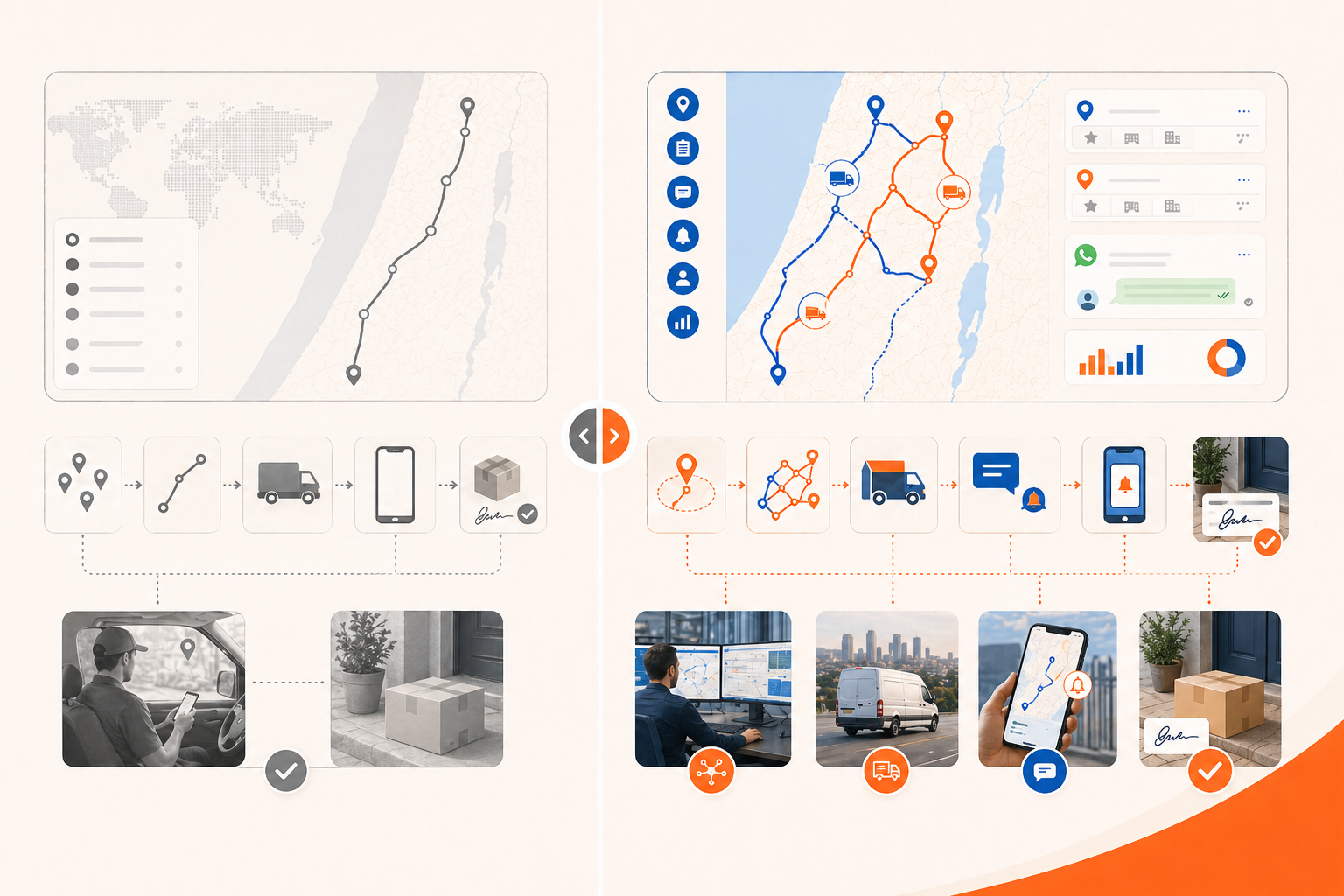
| Core framing | Stronger in route-led planning or global familiarity | Delivery orchestration across planning, dispatch, POD, messaging, and analytics |
| Israeli fit | Depends on local adaptation | Built around local addresses, WhatsApp, and local support reality |
| Named proof | Varies | Rami Levy is the proof point here: 35% fewer delivery delays, 18% fewer kilometers at the same volume, and 12% more stops per shift. |
| Best for | Teams whose needs stay narrow | Teams that need connected execution end to end |
Recent operator signals all point in the same direction. Onfleet and Bringg both reinforce that teams are being judged on reliability, visibility, and execution quality, not on a route demo alone.
That is why the buying language is shifting. Buyers are asking whether the platform can absorb real-world exceptions, keep dispatch control tight, and still give support teams a credible customer-facing answer when the day gets messy.
In practice, that means the evaluation has to look past a clean demo. Israeli operations usually combine dense urban windows, multilingual field teams, and customer expectations that punish weak execution the moment a route slips.
What to look for
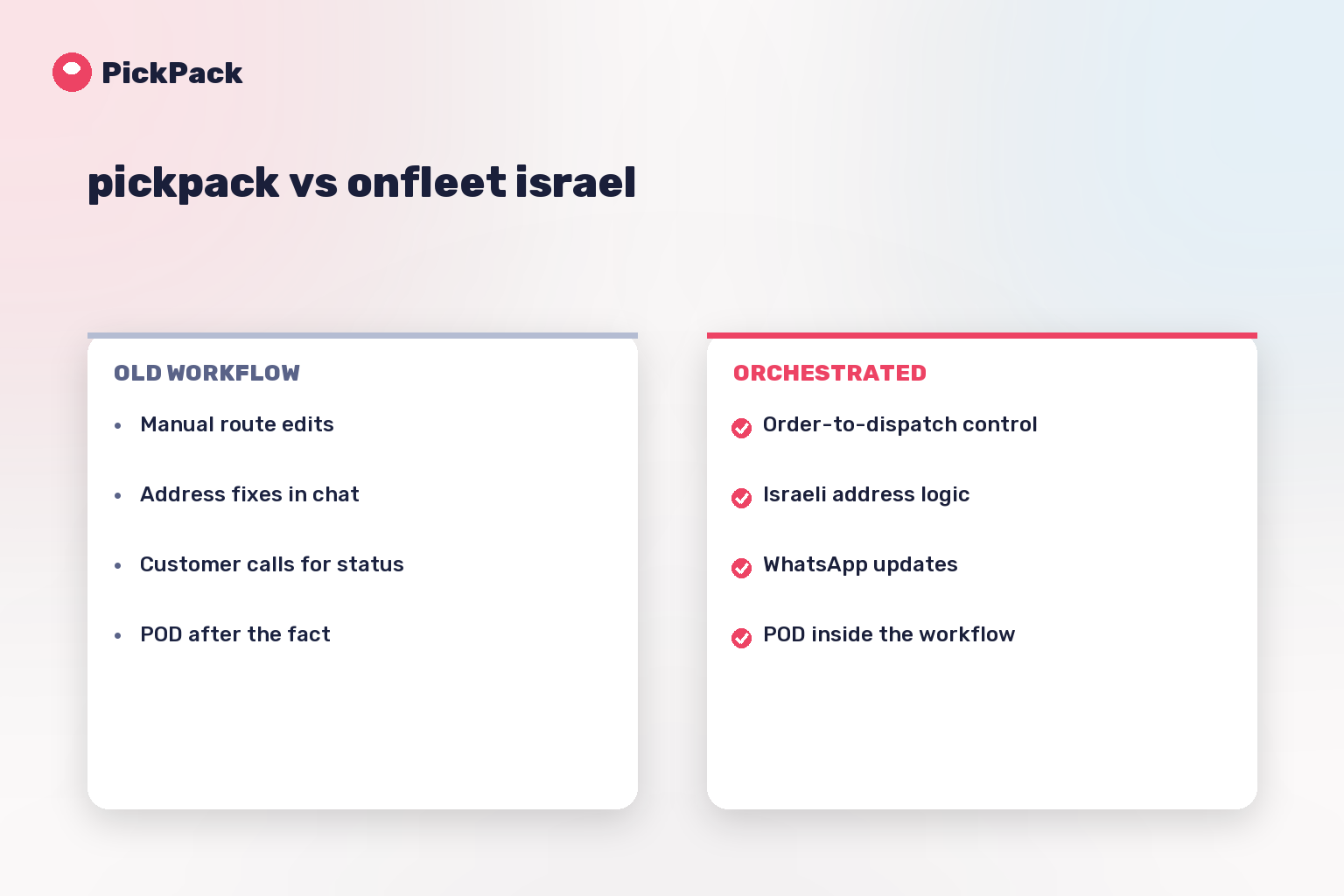
A strong evaluation is less about counting features and more about checking whether the platform keeps daily control when the route, the customer promise, and the field reality stop matching perfectly.
- Start with operational scope: are you comparing a route-led tool or a full orchestration platform against Onfleet?
- Check local fit: Priority ERP and SAP Israel integration.
- Check field execution: Dynamic dispatch and real-time rerouting and WhatsApp-native customer messaging.
- Check customer communication and exception handling: Multilingual driver app with Hebrew, Russian, and English support.
- Ask for named customer proof tied to a metric, not a generic ROI promise.
Measured results
Rami Levy gives this comparison a useful anchor: 35% fewer delivery delays, 18% fewer kilometers at the same volume, and 12% more stops per shift.
The point is not that every operation should expect the same number. The point is that a serious buyer should ask what combination of planning discipline, dispatch visibility, field proof, and customer communication makes a measurable improvement realistic.
The useful question is not whether another team can copy Rami Levy exactly. It is whether the same control logic can reduce delay pressure, protect service windows, and give dispatch better recovery options inside the current operation.
The honest buying question is not which brand is bigger. It is whether the operation needs route planning or full execution control.
How to put it into practice
- Map the operational handoff first: planning, dispatch, field execution, customer update, and proof.
- Pick one metric that the team can improve within 30 days instead of trying to optimize everything at once.
- Use named proof as the benchmark. Ask what would have to change to approach the kind of outcome seen at Rami Levy.
- Document exception rules in advance so the platform is judged on real work, not on the happy path only.
The teams that get value fastest do not start with every workflow at once. They pick one lane, one promise, one KPI, and one escalation path, then expand after the new control loop proves itself.
That is usually where weak projects are exposed. If the workflow still depends on spreadsheets, memory, or side-channel messages after the pilot starts, the team has not really upgraded execution yet.
Best fit and honest trade-offs
Onfleet can still make sense for teams whose main need is global product familiarity and a broad English-language ecosystem. That is the honest part of the comparison.
PickPack wins on Hebrew operations, Priority ERP, Israeli addresses, WhatsApp messaging, and local deployment fit.
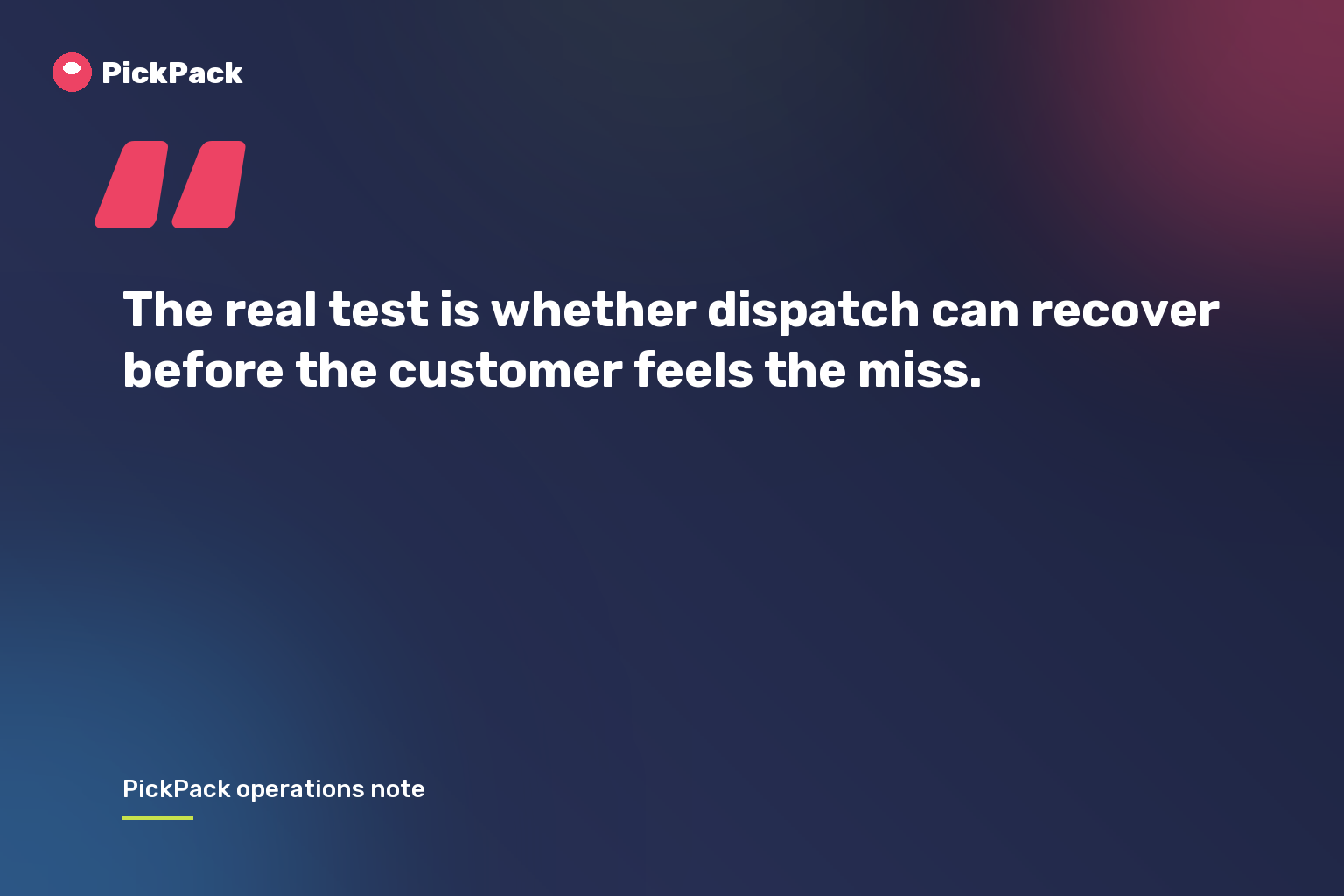
That reality check matters more in Israel than many software buyers expect. Dense city routes, last-minute substitutions, building-entry friction, and the need to answer customers fast all expose whether the platform truly helps dispatch recover during the day or merely reports the problem after the route is already lost.
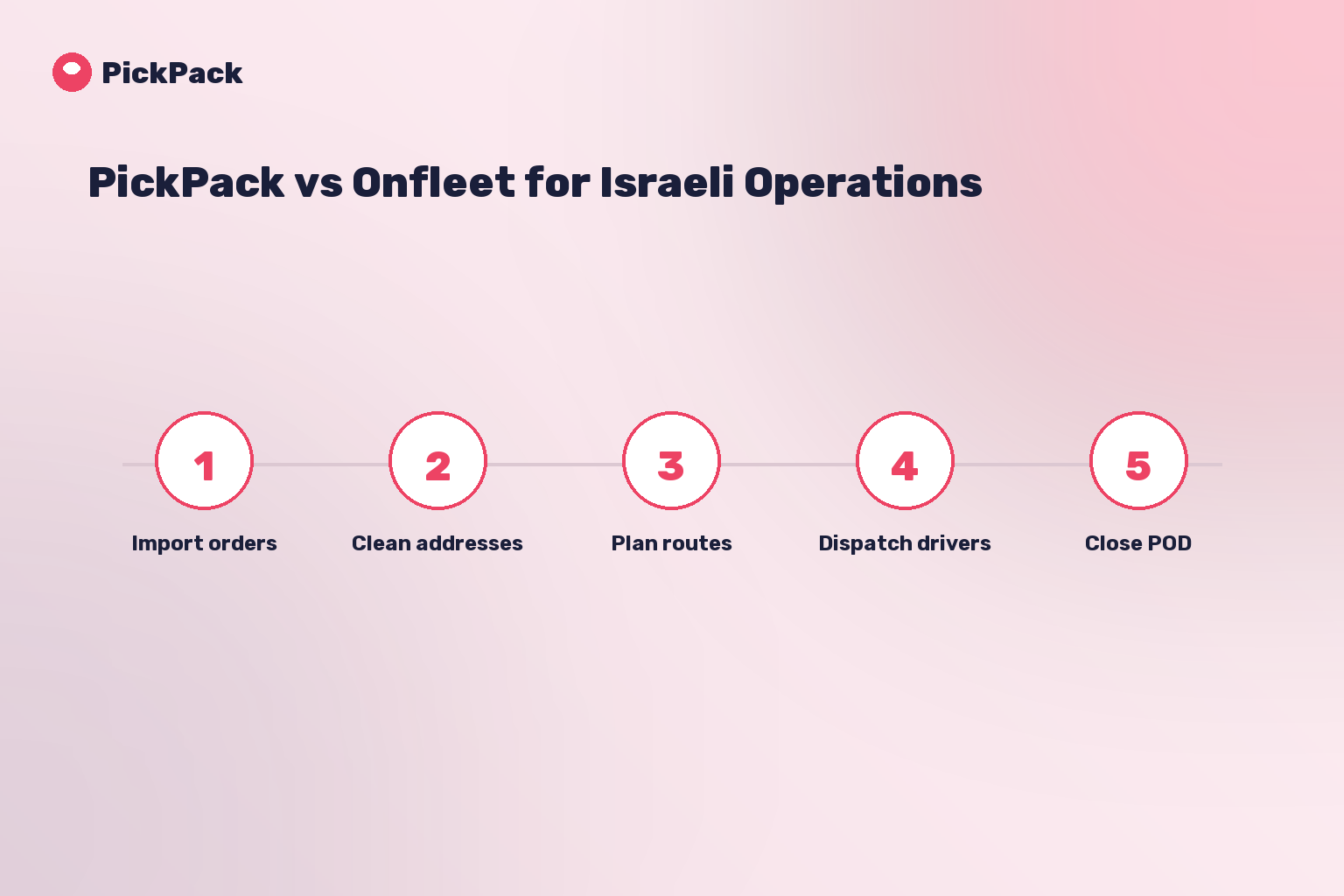
A serious pilot should use a real operating day, not a polished demo route. Pick one region, one dispatcher, and a representative driver group. Run the old workflow and the PickPack workflow against the same constraints: imported orders, address cleanup, promised windows, service-time assumptions, driver app use, customer messages, proof of delivery, and mid-day exceptions. The point is not to admire the map. The point is to see whether the team gets control back when something changes at 11:40.
The cleanest before-and-after scorecard has five lines: planning time, late-risk stops identified before departure, kilometers per completed stop, customer calls avoided through proactive messaging, and exceptions closed with usable proof. If those five numbers do not move, the project is not ready to scale. If they do move, the business has a practical reason to expand from one zone to more branches, more vehicles, and more complicated delivery promises. That is the difference between a software trial and an operational decision.
Two useful internal references before a vendor decision are Delivery management software guide and Artificial Intelligence in Last-Mile Delivery. They help frame the real operating questions behind this topic.
Related reading
- Route Optimization with Time Windows
- AI Address Validation in a Delivery Management System
- Delivery management software guide
- Artificial Intelligence in Last-Mile Delivery
FAQ
What is the main difference between PickPack and Onfleet?
PickPack is positioned as delivery orchestration, so the evaluation goes beyond route planning into dispatch, customer communication, proof, and analytics.
When does Onfleet still make sense?
Usually when the operation is narrower and the team mainly needs simpler routing or a more limited operational layer.
What should an Israeli buyer test first?
Address handling, driver workflow in the right language, WhatsApp communication, and integration reality.
What KPI should decide the pilot?
Use one daily-control metric such as delay rate, route adherence, or failed-delivery recovery time, and compare the result against the current baseline.
Sources and notes
- project44 – April 2026 release on AI agent orchestration, exception handling, and execution-focused logistics automation.
- Startup Nation Central – Israeli smart logistics landscape overview with local innovation context across warehousing, fleet, and last mile.
- Verified customer metric anchor: Rami Levy – 35% fewer delivery delays, 18% fewer kilometers at the same volume, and 12% more stops per shift.
- Suggested publish window from the Q2/Q3 strategy: 2026-06-01.
Book a 20-minute demo
The fastest next step is a live walkthrough of planning, dispatch, driver workflow, customer messaging, and proof inside a real Israeli delivery operation. see your projected savings in our calculator.
Book a 20-minute demo AI-driven delivery management platform.