

Last updated: April 24, 2026
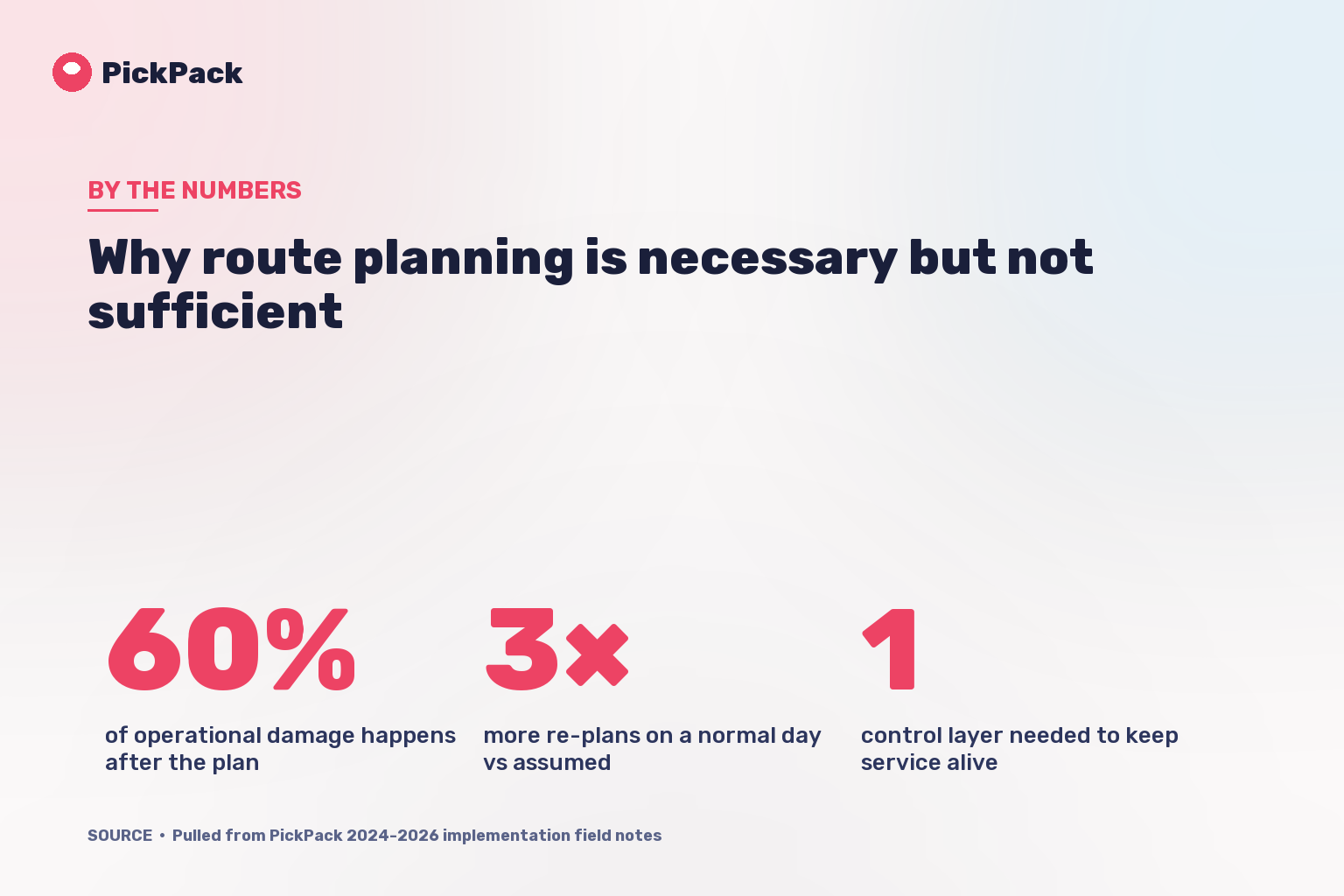
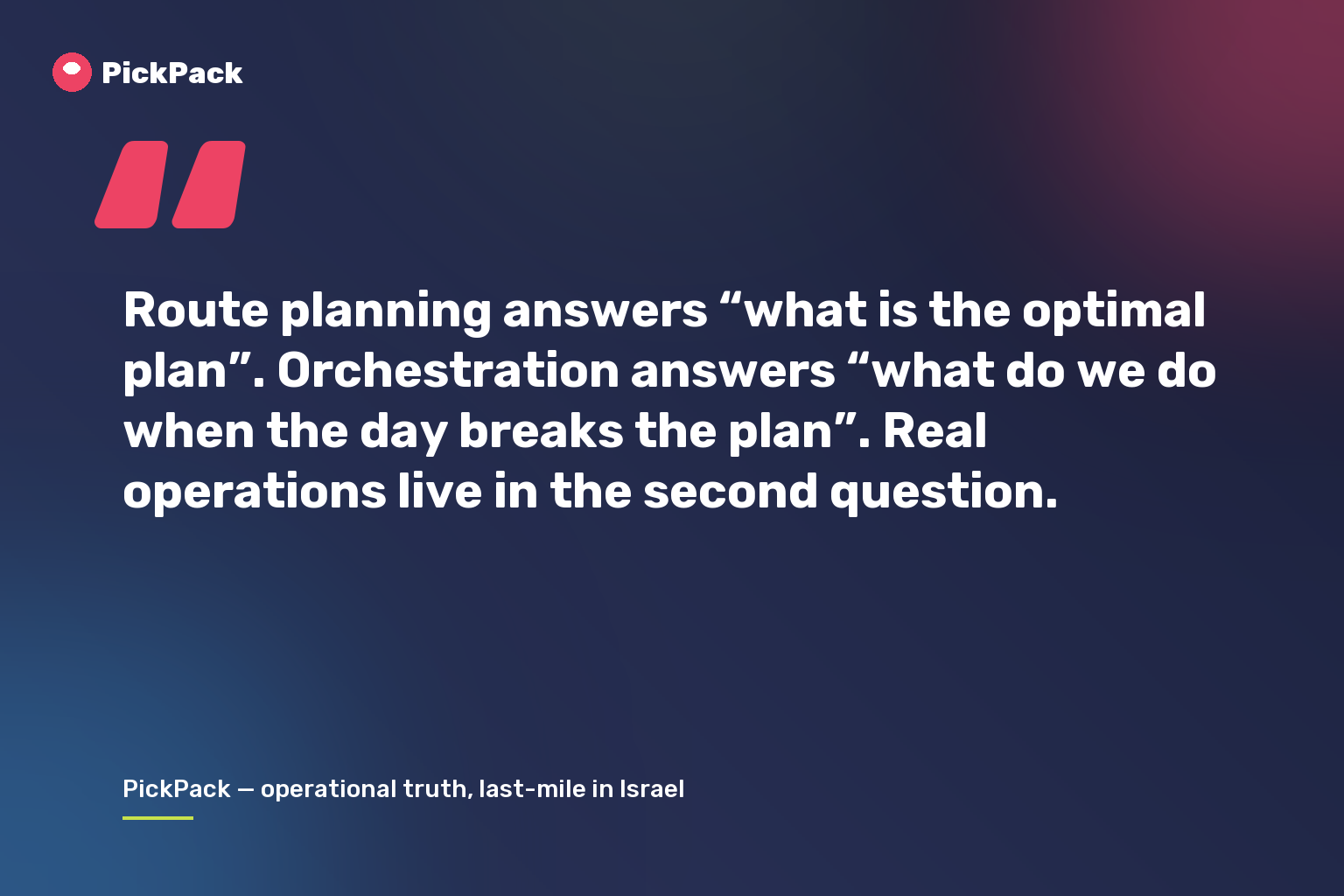
Route planning matters. But it is not the whole operating system. The real test starts after the plan is created, when the driver is late, the customer is unavailable, a new stop is inserted, or the promised ETA is no longer realistic.
That is why delivery orchestration starts where route planning ends.
Why this matters now
- The market is moving from disconnected tools to connected execution systems.
- Planned-versus-actual visibility is becoming an operational metric, not just a reporting view.
- Dispatch, customer communication, POD, and exception handling are now part of the same category conversation.
Why planned versus actual suddenly matters
Logistics Viewpoints wrote in April 2026 about a shift toward connected, agentic execution systems. That matters because operations teams are no longer asking only for a better morning plan. They want better control over what happens once reality diverges from that plan.
The same pattern is visible across the vendor market. Onfleet’s Q1 2026 product update and project44’s orchestration-focused AI announcement both point in the same direction: execution quality is now part of the core product story.
Route planning versus delivery orchestration
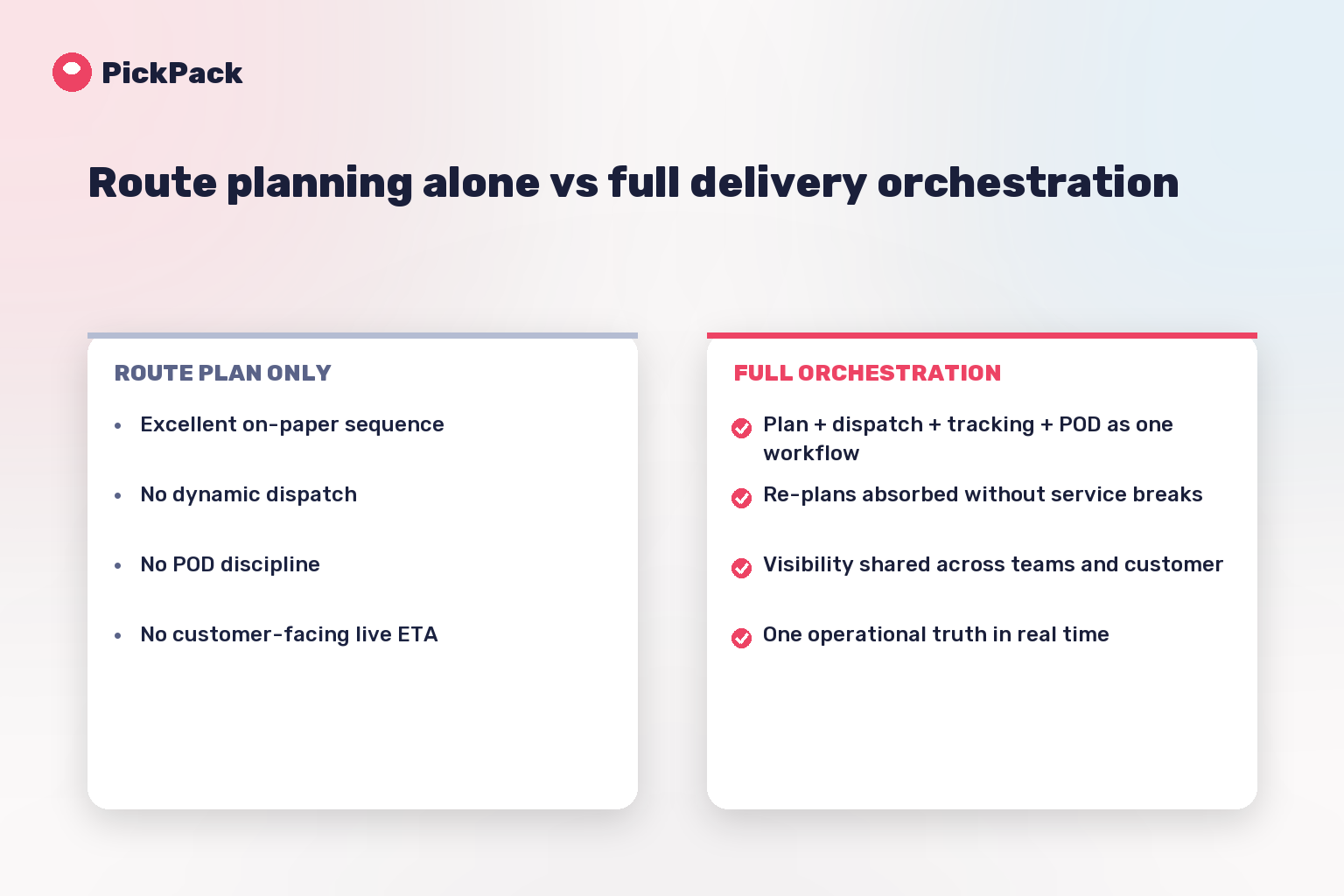
| Layer | Route planning | Delivery orchestration |
|---|---|---|
| Goal | Create the initial route sequence | Manage the day until every stop is resolved |
| Exceptions | Often handled outside the plan | Handled as part of live execution |
| Customer updates | Basic time promise | Live ETA, notifications, and closeout proof |
| Measurement | What the team planned | What actually happened against the plan |
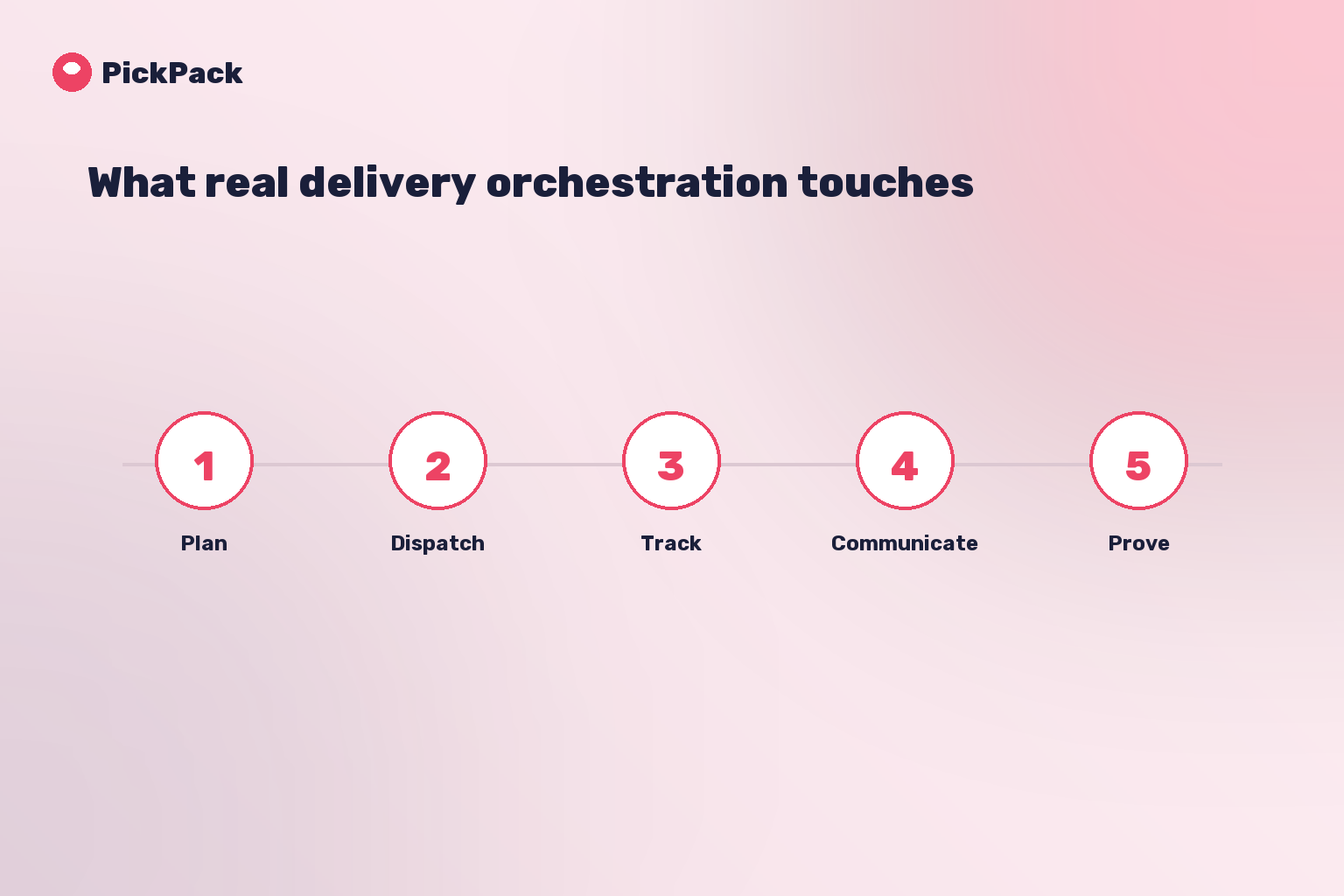
What delivery orchestration includes in practice
- An initial plan that gives the day structure.
- Dynamic dispatch when the day changes.
- Live visibility so operations, support, and drivers see the same truth.
- Customer communication tied to actual execution status.
- Proof of delivery and task closeout so the actual result is documented.
This is the core PickPack position: delivery orchestration, not just route planning.
Where PickPack fits
PickPack connects route planning, dynamic dispatch, driver execution, proof of delivery, customer messaging, and analytics in one operational layer. That matters because the route itself is rarely the part that consumes the whole day. The day gets consumed by change.
That is also where proof matters. According to PickPack’s approved customer data, Omer Deliveries cut planning time from 3.5 hours to 25 minutes while supporting 1,800+ daily shipments and 50% volume growth with the same team. That is what orchestration looks like operationally.
A practical checklist for evaluating orchestration claims
Teams should be careful with vendors that use orchestration language loosely. A route builder with a dashboard is still not necessarily an orchestration layer. The better test is operational, not branding-based.
- Can dispatch teams change the day live without rebuilding the whole plan manually?
- Can support see execution truth without calling the driver for every exception?
- Can customers receive updates tied to reality, not only the original route?
- Can the system document actual completion with proof of delivery and closed-loop statuses?
- Can managers compare planned and actual outcomes by route, driver, and customer promise?
If most of those answers are still “outside the system,” the operation probably has better routing, but not true orchestration yet.
FAQ
No. Routing is part of the answer. Orchestration manages what happens after the route is created and the day starts changing.
Because without that comparison, teams cannot tell whether the problem lives in planning, execution, or exception management.
If the morning plan looks fine but the rest of the day gets rebuilt through calls, chat threads, and manual interventions, the gap is execution orchestration.
Sources
- Onfleet Product Update Q1 2026
- Logistics Viewpoints: five transportation technology trends in 2026
- project44 AI agent portfolio announcement
Want to test whether your team needs better planning or better orchestration? Start with route planning, then track where execution keeps drifting away from the plan.